



How collaboration, environmental observations, and historical context are helping utilities adapt to an evolving wildfire landscape.
Wildfire risk is changing. Longer fire seasons, extreme weather events, and expanding development into fire-prone areas have made wildfire preparedness a year-round priority for utilities, emergency managers, researchers, and public agencies alike.
As the challenges evolve, so must the strategies used to address them.
PG&E has published and frequently updates its Risk-Informed Wildfire Mitigation Strategies and Strategic Communications Guidebook for Utilities, which brings together best practices from across the industry to help utilities strengthen their wildfire mitigation programs. Synoptic is proud to be included among the organizations contributing technologies and resources that support improved wildfire decision-making. Rather than highlighting a single solution, the guidebook emphasizes a layered, data-driven approach to reducing wildfire risk, built on collaboration, situational awareness, and informed decision-making.
Here are five key lessons that stand out.
1. Wildfire risk is no longer confined to traditional fire-prone regions
For many years, wildfire preparedness was primarily associated with the western United States. Today, that assumption no longer holds true.
Climate change, prolonged drought, changing vegetation patterns, and rapid transitions between wet and dry conditions are creating wildfire risk in regions that historically experienced far fewer large fires. The guidebook notes that wildfire risk continues to expand geographically and seasonally, requiring utilities and communities everywhere to rethink how they prepare for these events.
This shift means organizations are incorporating more reliable environmental observations into their operations, and across a much broader geographic footprint than ever before.
2. Situational awareness starts with quality observations
A strong theme throughout the guidebook is that effective wildfire mitigation begins with situational awareness.
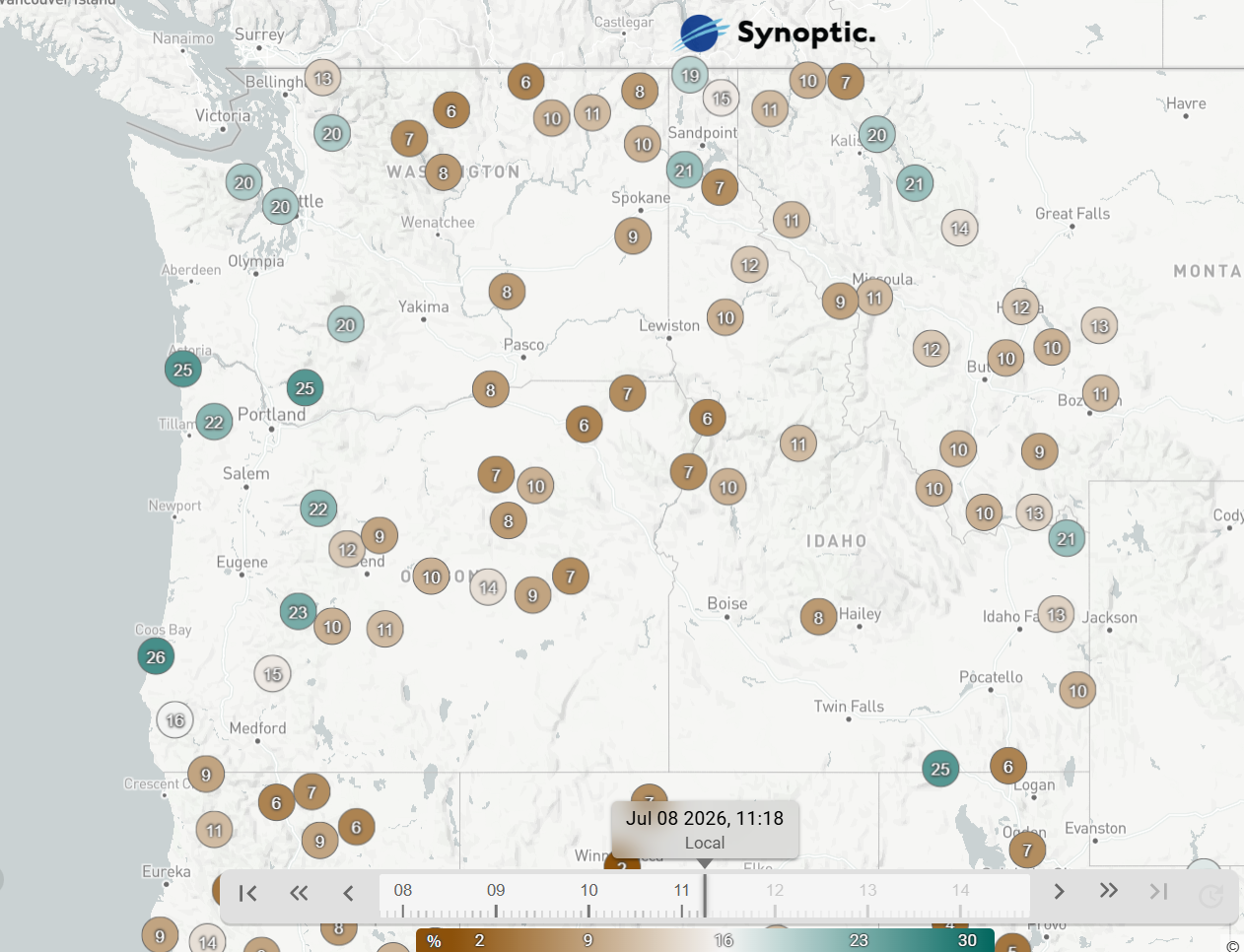
Utilities increasingly rely on a combination of weather stations, forecasting systems, satellite observations, cameras, and field intelligence to understand rapidly changing conditions. Weather observations serve as one of the foundational inputs that support operational decisions before, during, and after critical wildfire events.
At Synoptic, we’ve long believed that making environmental observations easier to discover and access helps improve decision-making. Synoptic’s Weather API aggregates data from more than 320 public and private observing networks, including the RAWS (Remote Automated Weather Station) network, giving users access to millions of quality-controlled observations through a single platform.
Whether monitoring wind, humidity, temperature, precipitation, or fuel moisture, timely observations provide the foundation upon which more sophisticated analyses are built.
3. Better decisions require more than real-time data
Real-time observations are essential, but numbers alone don’t always tell the whole story.
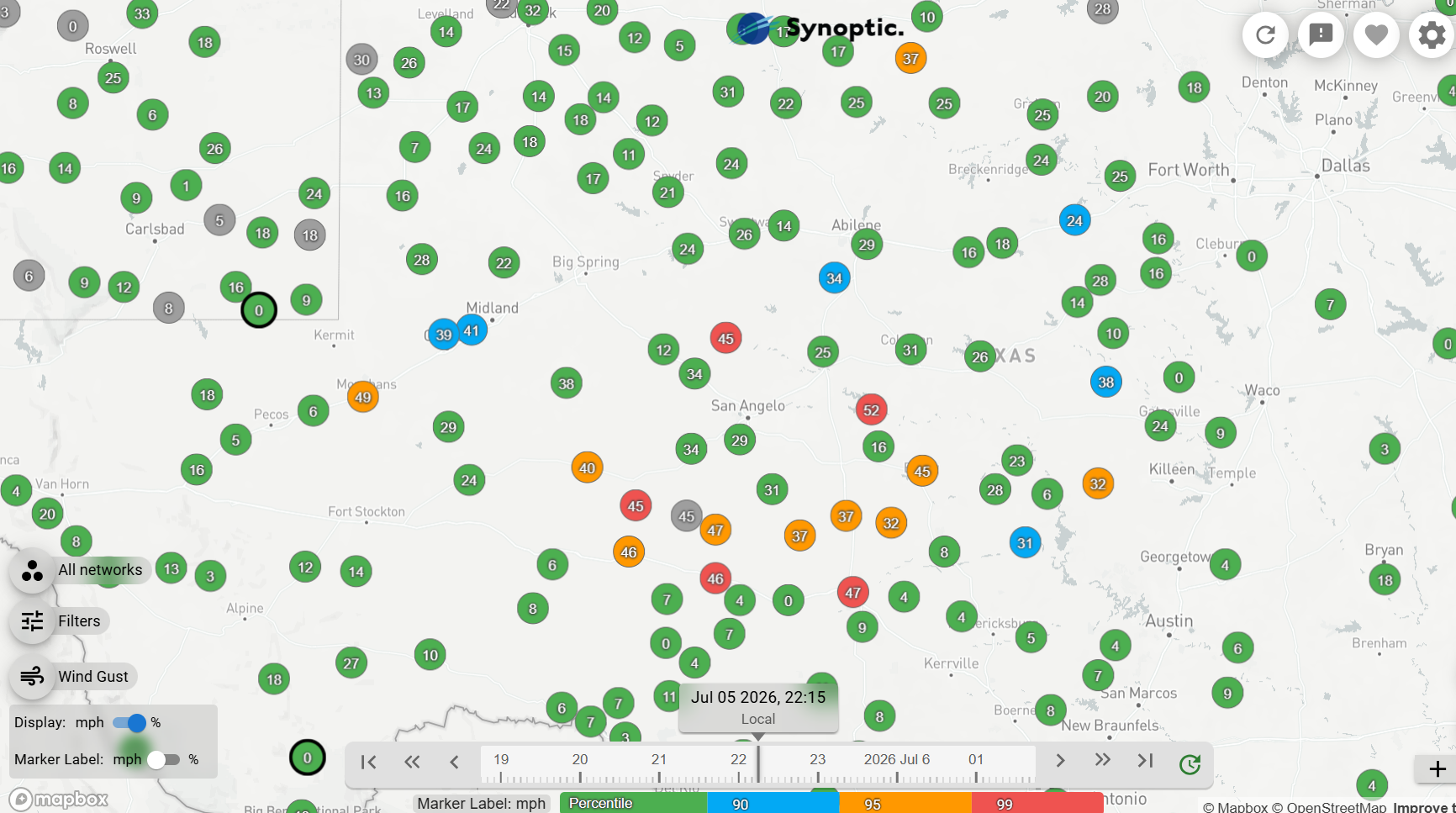
Consider a reported wind gust of 50 mph. Is that typical for this location? Is it unusually strong? Has this station experienced conditions like this before?
Historical context helps answer those questions.
Recognizing this need, Synoptic recently introduced Station-Based Wind Percentiles, allowing users to compare current observations against each station’s historical record. Rather than evaluating raw wind speeds alone, decision-makers can quickly understand whether current conditions fall within the 90th, 95th, or even 99th percentile for that specific location. This includes access to a color-coded display to immediately assess where significant conditions are occurring.
That additional context helps transform weather observations into operational intelligence.
4. Wildfire mitigation is built on layers, not a single solution
There is no single technology capable of preventing catastrophic wildfires.
The guidebook describes wildfire mitigation as a layered approach that combines weather monitoring, forecasting, risk modeling, operational procedures, vegetation management, infrastructure improvements, and community resilience. Together, these complementary strategies help reduce both the likelihood and consequences of wildfire events.
Environmental data supports many of these layers simultaneously.
Weather observations feed forecasting systems. Forecasts inform operational planning. Historical data supports risk modeling. Real-time observations validate changing conditions as events unfold.
Each layer becomes stronger when supported by accurate, reliable environmental information.
5. Collaboration is driving innovation across the wildfire community
Perhaps the biggest takeaway from the guidebook is that wildfire mitigation has become a collaborative effort.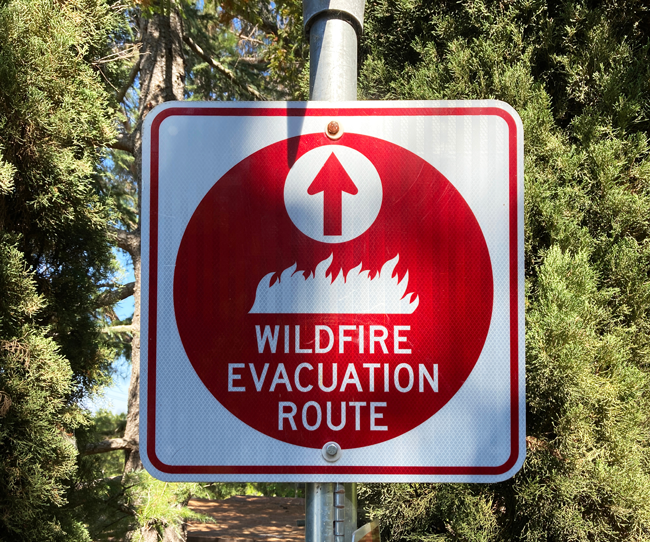
Utilities, government agencies, researchers, technology providers, meteorologists, and emergency managers are increasingly working together to share data, improve forecasting, and develop better operational practices. The guidebook itself was created to encourage that collaboration and accelerate the adoption of proven wildfire mitigation strategies across the industry.
We’re honored that Synoptic’s work is included among the technologies highlighted in this resource. As a Public Benefit Corporation and Certified B Corporation, our mission has always been to make weather and environmental data easier to access and use. Supporting wildfire preparedness is one of the many ways we see that mission making a real-world impact.
Setting the Foundation for the Future
Wildfire mitigation will continue to evolve as new research, technologies, and operational practices emerge.
But one principle remains constant: better decisions begin with better information.
By providing trusted access to quality-controlled environmental observations, and by helping place those observations into meaningful historical context, we hope to continue supporting utilities, researchers, emergency managers, and communities working to better understand and respond to wildfire risk.
The future of wildfire mitigation isn’t about any single technology. It’s about bringing together the right information, at the right time, to help people make better decisions when they matter most.
Learn more about Synoptic’s Weather API, Station-Based Wind Percentiles, and the environmental data powering smarter wildfire decisions.