



Synoptic Data 2025 Report Reveals December’s Heat and Wind Capped a Dramatic Year in Weather
The 2025 Weather in Review report illustrates what’s possible using real-time weather and environmental insights for decisions that matter
Synoptic released its 2025 Weather in Review report, revealing windstorms, temperature extremes, and rapid-onset flooding, punctuated by intense December weather, served as a powerful reminder that weather risk no longer follows a calendar — and that timely, high-quality data are essential when every second counts.
The report, built from real-time observations across the Synoptic platform, shares key highlights from 2025, as well as how users across government, academic, and private sectors leveraged Synoptic’s API to turn raw observations into actionable understanding — comparing real-time values to long-term behavior, identifying anomalies, and making sense of fast-changing events.
Key Highlights from Synoptic’s API in 2025:
- Record Temperatures On Christmas Day
Thousands of stations recorded temperatures above the 99th percentile — some as high as 30 degrees above average — providing evidence of a historic heat event throughout the U.S. In fact, nearly 2,000 of these “winter” temperature observations were record highs on Christmas Day.
- Fast-Onset Flooding
 In Texas, rainfall accumulation surged from less than a half inch per hour to nearly three inches per hour in just 60 to 90 minutes on July 4, 2025. Streamflow and gauge heights rose extremely rapidly, demonstrating the importance of high-frequency, real-time observations for situational awareness and saving lives.
- High Wind Events Across Mountain and Plains Regions
 Just before Christmas on December 17-18, stations in the West captured wind gusts above 100 mph, and percentile analysis showed more than 1,000 stations registering higher than 99% of historical measurements, offering critical context for hazard evaluation and confirming how anomalous the event truly was.
The observations from Synoptic’s platform helped answer critical questions for forecasters that depend on real-time weather information:
- How extreme is this wind event compared to typical conditions?
- Where is flooding likely to intensify next?
- Is an anomalous temperature spike local — or nationwide?
“At Synoptic, we focus on data and empowering users with the observations they need to make timely and informed decisions,” said Ashish Raval, president and CEO of Synoptic Data. “When you’re making decisions that affect communities, infrastructure, or safety, having reliable, real-time observations in one place isn’t a convenience — it’s critical. Our annual data report was developed to demonstrate how easily users can pull data from our platform and use it for their operations and decision-making.”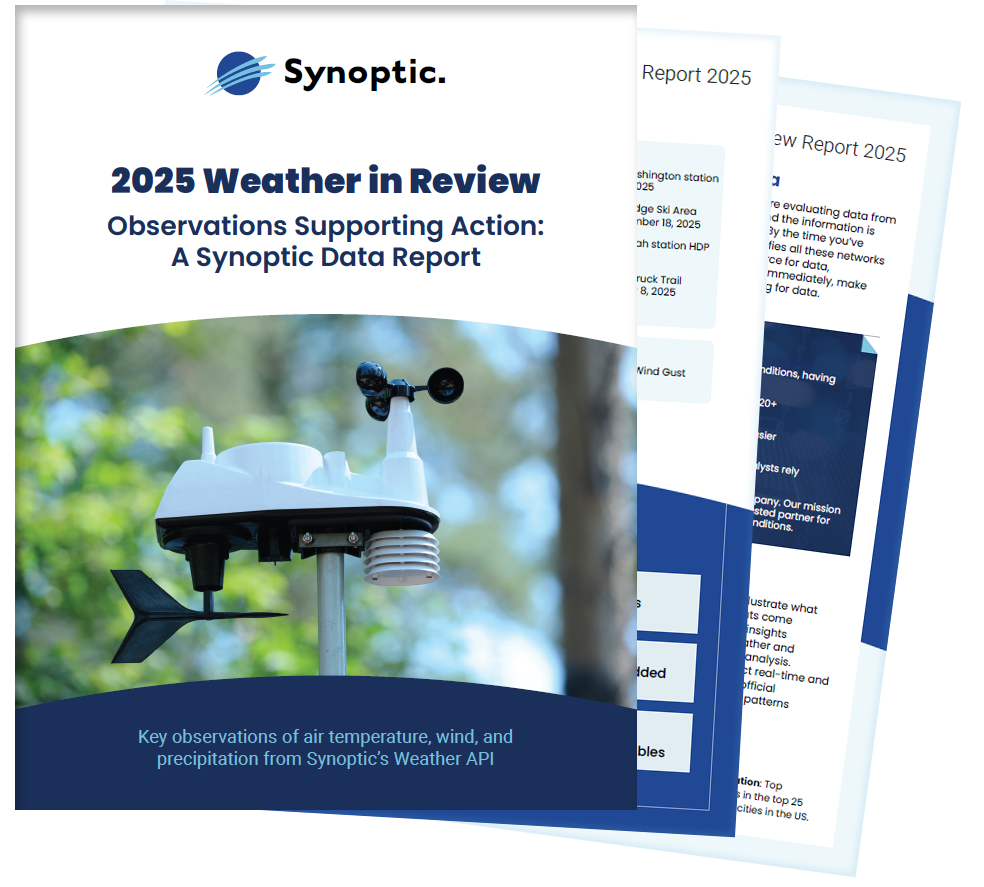
The Synoptic Weather API sets the foundation to make it simple for organizations to pull insights — like the ones highlighted in the report, compare, and analyze weather information. From federal agencies and research institutions to utilities and private forecasting services, users leveraged the system every day to support planning, operations, and public safety.
“Analysis of the events from 2025 demonstrates how powerful the intersection of data volume, accessibility, and context can be,” said Toby Meierbachtol, technical product manager at Synoptic Data. ”The report illustrates how modern observational networks are transforming the nation’s weather intelligence infrastructure. Every added station, every ingested parameter, and every API query provides decision-makers with a more complete picture of conditions to protect communities and infrastructure.”
As a Public Benefit Corporation and certified B Corp, Synoptic continues to expand access to weather and environmental data, partnering with data providers large and small to share observations that were once siloed, difficult to access, or entirely undiscovered.
View the full report to see how it demonstrates why scale, quality, and context matter — and how a unified platform lets users keep pace with the atmosphere rather than chase data across dozens of sources.