



When Minutes Matter: Inside Watch Duty’s Real-Time Approach to Wildfire and Flood Intelligence
How real-time observations, human expertise, and innovative technology come together to help communities understand rapidly changing conditions.
When a wildfire is moving toward a community, conditions on the ground can change quickly. Winds shift. Humidity drops. Temperatures climb. Evacuation zones change. For the people nearby and the first responders working the incident, understanding what’s happening right now can be just as important as knowing what’s next.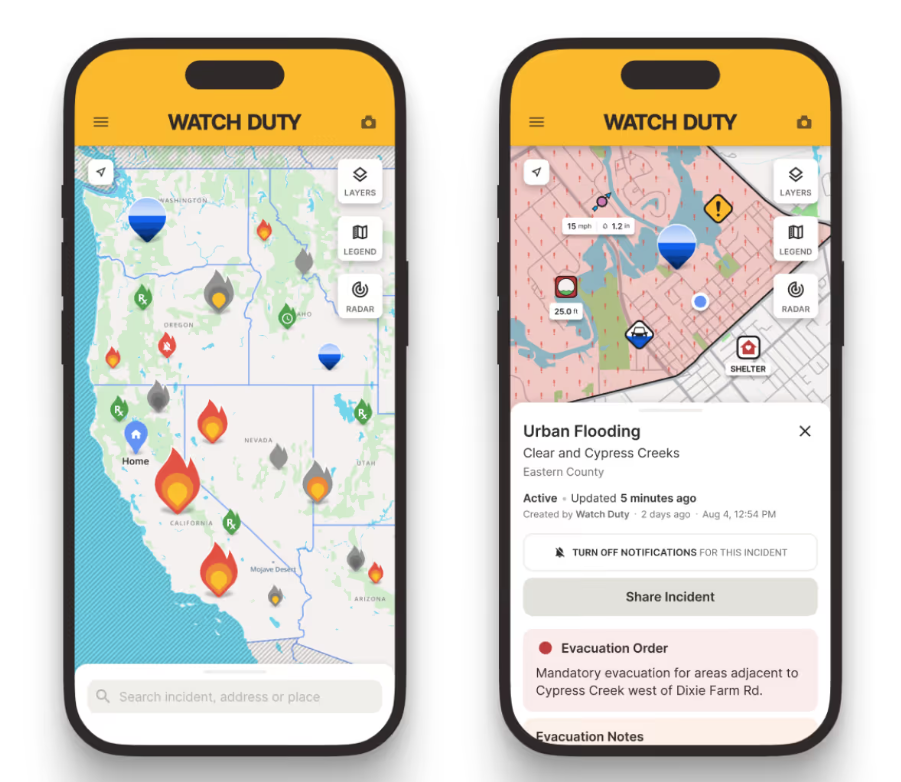
That’s the challenge Watch Duty was created to address. The 501(c)(3) nonprofit has become a trusted source of real-time wildfire alerts and on-the-ground intelligence, bringing together official information, radio communications, weather observations, cameras, and insights from first responders. Not only does Watch Duty provide critical wildfire alerts, but more recently, Watch Duty has expanded their approach to major flooding, where rapidly changing rainfall, stream conditions, warnings, and evacuations create a similar need for timely, localized information.
More than 30 million people across the United States have used Watch Duty to track local conditions and make informed decisions. Behind the technology are more than 450 staff and volunteers, including active and retired emergency dispatchers, first responders, and reporters who work around the clock to gather information, verify what’s happening, and communicate it clearly.
Real-time environmental observations from Synoptic, a real-time weather and environmental data platform, are one piece of that larger information ecosystem, helping Watch Duty’s team and its users see what conditions are actually happening on the ground.
From an Observation to Actionable Information
“Data from Synoptic in Watch Duty serves two main purposes,” says Brian Harris, Chief Product Officer at Watch Duty: powering the real-time observation data that staff and end users see directly in the app, delivered through Synoptic’s Weather API, and supporting the analysis Watch Duty’s own teams do behind the scenes. As Harris explains, “For our reporting operations team, weather stations provide real-time insights into ground conditions that help us understand fire behavior and potential impact area. Watch Duty operations also use custom alerting for monitoring precipitation as an early signal for potential flood events. For our end users, they are able to configure personalized threshold-based alerts for the weather stations closest to them.”
When the National Weather Service issues a Flash Flood Warning based on radar-indicated rainfall, for example, Watch Duty’s team can look at observations from precipitation gauges on the Synoptic platform within the warning area. If those stations are measuring significant rainfall, the observations can help “ground truth” what radar is indicating. The Watch Duty team can then take the analysis another step further by looking at nearby stream gauges. As rainfall reaches a river basin, reporters can watch for streams and rivers to respond, helping them build a more complete picture of how the event is evolving.
Recent river flooding in Indiana provided a good example of Watch Duty’s implementation of Synoptic’s real-time data into their application. “The event started as flash flooding, and looking at the precipitation gauges and the early response from the streams and rivers, it was clear in short order that this was going to be much more than a flash flood issue that was over quickly,” said Geoff Havens, Manager of Flood Operations at Watch Duty.
That ability to compare multiple sources is especially important when minutes matter. Watch Duty doesn’t rely on a single observation or alert; information is cross-checked with other available data to help reporters understand what is happening before communicating it to the public.
What 45 Minutes Can Look Like
That combination of speed, verification, and human expertise was on display during the Cottonwood Fire Burn Scar flash flooding in July and August 2026.
During the fast-moving and dangerous event, Watch Duty brought Wireless Emergency Alerts (WEAs), evacuation zones, camera imagery, weather observations, National Weather Service warnings, and official information from social media together in one place. Watch Duty also used a Critical Alert to notify people in affected areas about the seriousness of the situation.
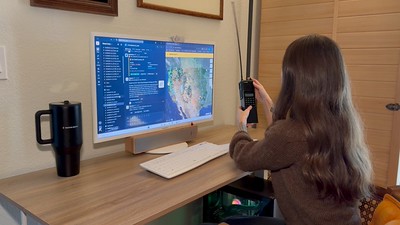 Much of the event’s escalation, which included a WEA, a Flash Flood Emergency, and activation of evacuation zones, occurred within approximately 45 minutes. “It was an all hands on deck effort by three reporters to ensure life-saving information was pushed to the public in a timely manner,” Havens said.
It’s an example of the challenge Watch Duty’s team faces during both fires and floods: information can arrive quickly from many different sources, but it still has to be evaluated, connected, and communicated in a way that helps people understand what is happening. Increasingly, real-time data and technology are helping Watch Duty’s human reporters do just that.
Meet Watch Duty’s “Friendly Robot Data Translator”
One of the more unexpected ways Watch Duty puts data from Synoptic to work happens entirely behind the scenes. Watch Duty has developed an internal bot known as the convergence tool, which Havens describes as the company’s “friendly robot data translator.”
The tool looks across precipitation gauge and stream gauge data from the Synoptic platform, National Weather Service products, evacuation information, Weather Prediction Center rainfall discussions, and other information to flag areas of potential concern for Watch Duty reporters. The convergence tool helps point Watch Duty reporters toward situations that may deserve their attention.
In some cases, it can identify developing areas of concern before evacuations are announced. That gives Watch Duty’s reporting and meteorology teams additional time to investigate what’s happening. “Extra time equals more room to take life safety actions for the users,” Havens said. “This bot, using data from Synoptic’s platform, is becoming an increasingly important part of the flood analysis process alongside our reporting and meteorology teams.”
Watch Duty’s convergence tool is a powerful example of how environmental observations are more than points on a map. When observations are combined with other sources and the expertise to interpret them, they can help reveal a developing situation sooner.
Real-Time Data Helps Tell the Story
Real-time data is a critical part of Watch Duty’s services, and it’s most powerful when used alongside other information sources. When asked what would happen if Synoptic’s platform disappeared tomorrow, Havens put it simply: “No one thing breaks, but a great many things become weaker, less useful, and potentially slower.”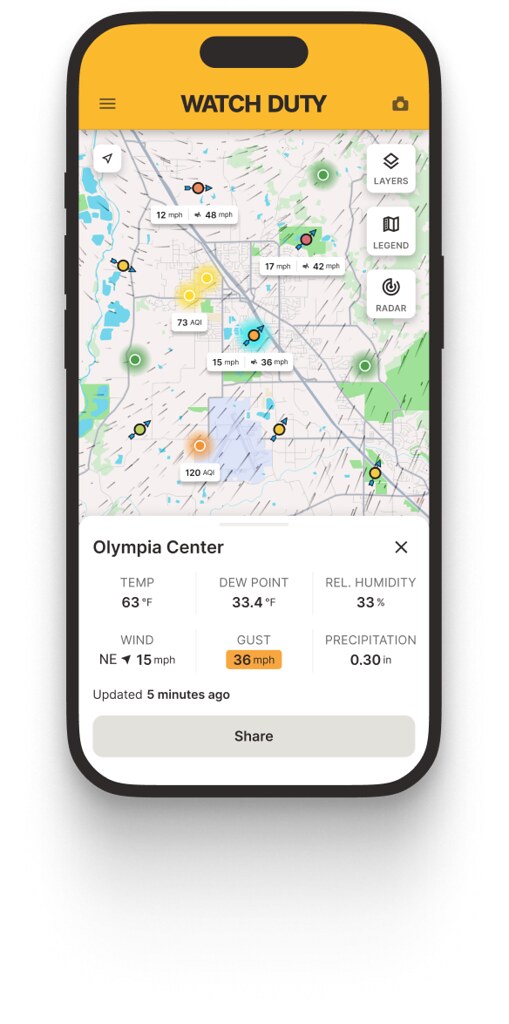
For flood operations, verification of weather impacts could become more difficult and time-consuming, and the convergence tool could be slower to recognize developing situations. Users monitoring rainfall near their homes would also have one less source of localized information. And the impact would extend well beyond flooding: “The wind data Synoptic provides is hugely helpful on the fire side when working to understand what the wind will do on a fire, how hot an area is, humidity impacts, etc.,” Havens said.
Ultimately, the value of real-time environmental data comes down to how it is used. Whether it’s a Watch Duty reporter evaluating an evolving incident, a meteorologist connecting rainfall to rising streams, or someone monitoring conditions near their home, timely observations provide another piece of information that can help people understand what’s happening around them.
During wildfires, floods, and other rapidly changing weather events, real-time data alongside other information can bring a clearer, more contextualized picture at a critical moment. By bringing observations together with warnings, cameras, evacuation information, and other trusted sources, Watch Duty is helping to bring a growing volume of weather intelligence to people who can use it to make informed, potentially life-saving decisions — the same mission Synoptic, a Public Benefit Corporation, was built to support.