



How Adiabat Accelerates Hurricane Wind Footprint Analysis with Synoptic Data
When a hurricane affects the U.S. coastline and makes landfall, the damage left behind only tells part of the story. Understanding the full impact requires knowing exactly where the strongest winds occurred and how those conditions changed across time and space. That’s where Adiabat and Synoptic Data come in.
Adiabat tailors weather solutions to the industries that need them most: insurance, engineering, agriculture, and more. Based in Virginia, Adiabat is a weather and climate consulting firm that specializes in transforming complex atmospheric data into decision-ready insights. Using atmospheric science, historical weather data, and GIS (Geographic Information System), they create detailed hurricane, flood, and snowfall “footprints” for industries that depend on speed and accuracy.
One of their core offerings: hurricane wind footprint analysis.
The Challenge: Fast, Accurate, and Defensible Wind Analysis
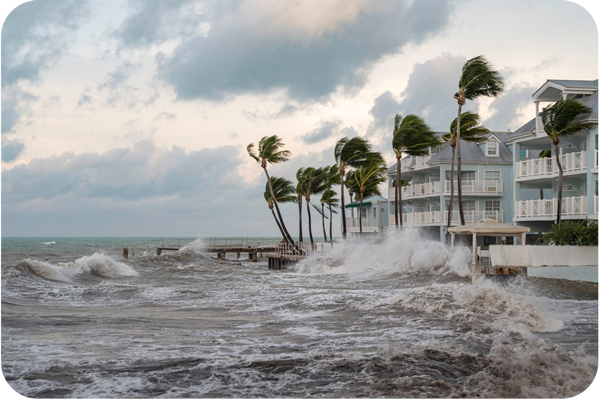 After a hurricane makes landfall, Adiabat produces detailed wind footprint datasets for their clients in order to assess where the greatest impact occurred. The analysis provides geospatial wind layers that map the extent and intensity of winds from the hurricane event. These footprints are used for various decisions, including:
- Verifying insurance claims
- Supporting engineering and compliance reporting
- Guiding emergency response and recovery efforts
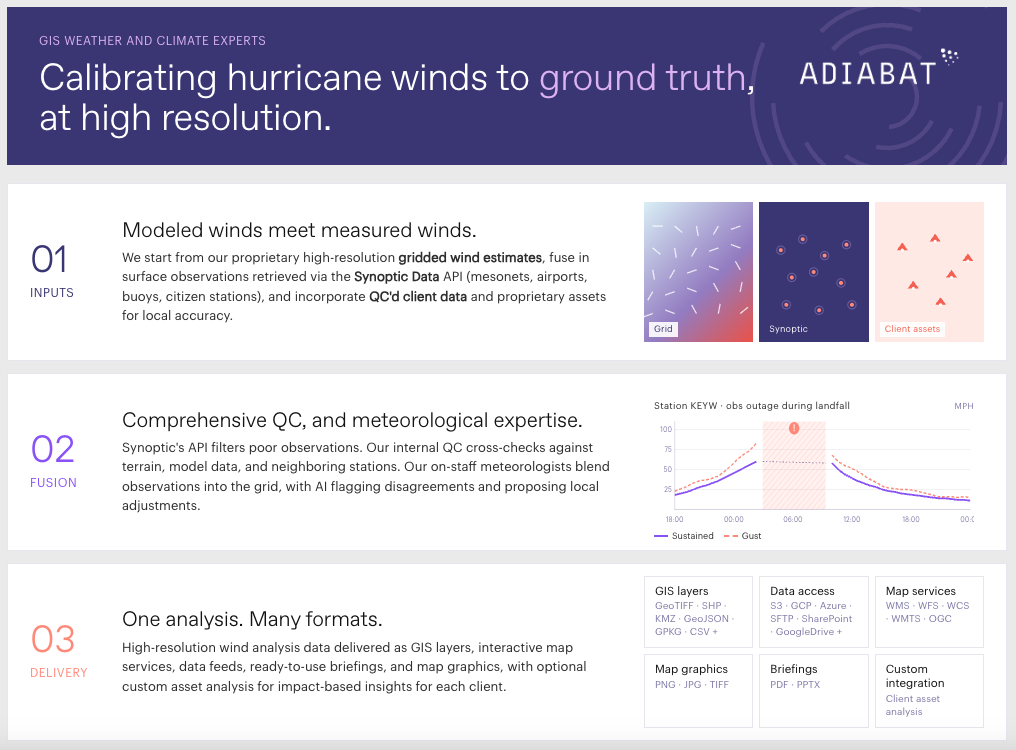
Creating these footprints is no small task. The process requires blending Adiabat’s modeled wind data with real-world wind observations from hundreds of weather stations, then verifying, quality-controlling, and calibrating that data to ensure accuracy.
“Initial footprints are typically delivered within 24 to 48 hours for our clients,” explains Ashley Ballard, co-founder and certified consulting meteorologist (CCM) at Adiabat. “Therefore, time is of the essence.”
Before working with Synoptic, much of this process was handled in-house. Their team had to manually collect station data from multiple sources, perform quality control checks by hand, and calculate statistics across large, cumbersome datasets.
While the solution was fulfilling the needs for their customers, it also meant:
- Spending hours on QC for each event
- Compiling weather observations from multiple sources
- Manually quality controlling data and aligning data into consistent formats from the various sources
- Having a limited ability to scale quickly during large-impact storms
“Weather station data is messy,” Ballard notes. “Stations have data gaps, sensor errors, and varying reporting standards. Making everything consistent was a challenge.”
The Solution: Streamlined Data Access and Built-In Quality Control
Adiabat turned to Synoptic to simplify and accelerate their workflow. Today, they rely on the Synoptic Weather API for unified access to real-time and historical weather station data and on the Statistics & Percentiles service to quickly benchmark hurricane wind data against historical values. Adiabat receives wind speed, direction, and gust observations; quality control flags; and historical data, along with the percentiles from the API. Adiabat also uses the Data Viewer and Metadata Explorer for quick visibility into station availability and metadata.
Instead of stitching together data from multiple sources and running quality control checks manually, Adiabat can now access quality-controlled observations from a single platform that provides ready-to-integrate data directly into their workflows. These data points allow their meteorologists to quickly assess how observed winds compare to historical norms, identify anomalies, and ensure consistency across the footprint.
“Utilizing Synoptic’s API saved us from having to compile observation data from multiple sources and format it for consistency,” Ballard says. “And the Statistics and Percentiles Service allows us to focus more on interpretation and application of the data versus analysis. The percentiles also help put events into context when communicating with clients,” Ballard notes.
The Impact: From Hours to Minutes and Better Results
“What used to take several hours now takes minutes.” By eliminating manual quality control and streamlining data access, Adiabat has significantly reduced turnaround time without sacrificing quality. With access to more observational networks and quality-controlled data, Adiabat has been able to:
- Increase the number of observations used in each analysis
- Improve confidence in calibrated wind footprints
- Deliver faster, more defensible results to clients
The downstream impact for their clients is just as meaningful with:
- Faster delivery of post-storm insights
- Higher-resolution datasets: up to 4x greater spatial resolution
- Stronger support for decision-making across industries
Why It Matters: Trust and Efficiency in Weather Data
Adiabat’s meteorologists already utilize weather data for their tailored client-ready weather intelligence. The question is how to do it faster with sources their meteorologists can trust. “Weather data is everywhere, and a lot of it is freely available,” Ballard explains. “The challenge is making sure it is consistent, trustworthy, and usable.”
That’s where Synoptic delivers value. By providing quality-controlled observations with built-in context, Synoptic allows teams like Adiabat to spend less time wrangling data and more time applying it.
“If you’re evaluating observational data sources, it comes down to trust and efficiency,” Ballard says. “Synoptic provides both.”
Looking Ahead
As demand for climate risk analysis and post-event insights continues to grow, including hurricanes, floods, and snowfall impacts, the ability to deliver fast, accurate, and scalable weather intelligence is more important than ever.
For Adiabat, combining their domain expertise with Synoptic’s data infrastructure is helping them do exactly that, turning complex weather data into actionable insights when it matters most.